
An expense tracker is only half a budget. The other half is the number coming in, and for a PhD student that number is mostly decided before you arrive, by your field. So before the apps, here is the income side: the phd stipend average by field, computed from our own database of 798 programs at 100 universities. Of those programs, 265 publish a 12 month stipend, and those published figures are what every number below is built on.
The phd stipend average by field, in monthly amounts
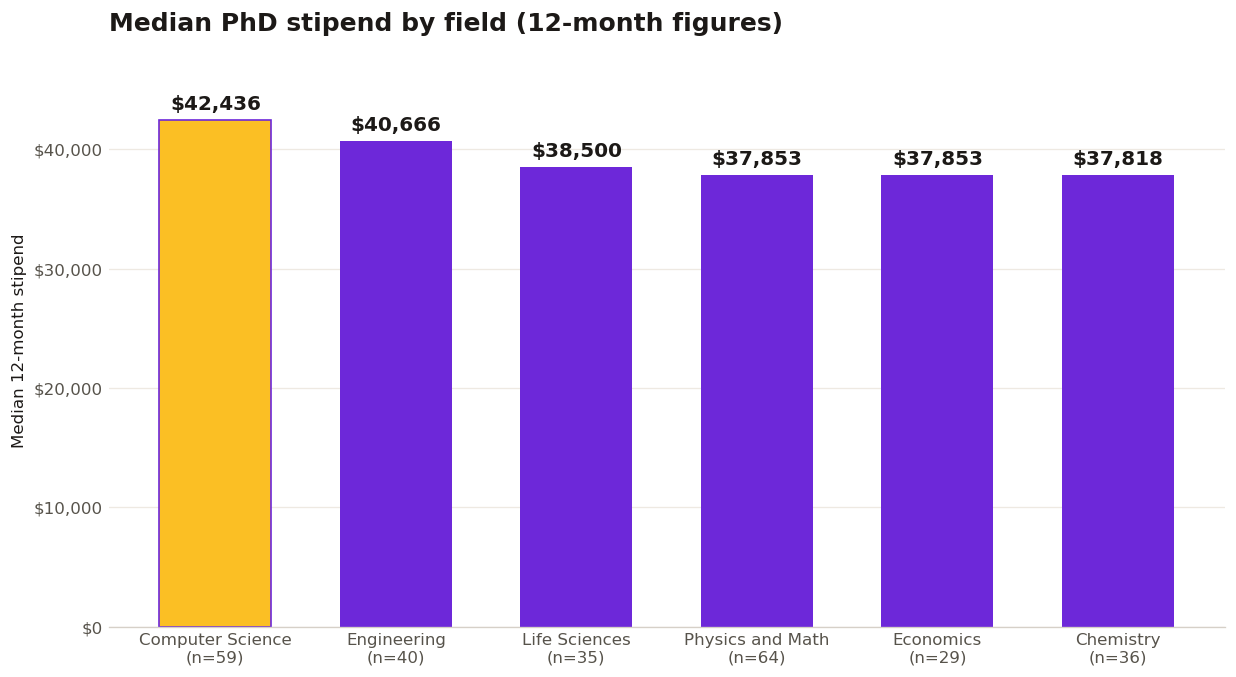
Computer science sits on top with a median of $42,436 a year, which is $3,536 a month before tax. Engineering follows at $40,666 ($3,389 a month), then life sciences at $38,500 ($3,208 a month). Physics and math and economics land together at $37,853 ($3,154 a month), and chemistry closes the list at $37,818 ($3,152 a month). The median across all 265 programs is $40,000, or $3,333 a month.
The gap between the best and worst paid field groups is $4,618 a year. That sounds abstract until you divide it: $385 a month, every month, for five or six years. It is roughly a car payment, or the difference between a studio and a shared house in a mid priced city. Two students at the same university, in different departments, can be living on noticeably different incomes while paying the same rent. That is why a single generic grad school budget rarely fits anyone.
It is also why your tracker categories should be built from your field's number, not from a national average. A chemistry student on $3,152 a month needs hard caps on the flexible categories, because there is almost no slack to absorb a bad month. A computer science student on $3,536 has more room, and the bigger risk is lifestyle creep: delivery food, subscriptions and conference travel that quietly eat the advantage the field gave them.
Five expense trackers, matched to stipend life
The five trackers from our original comparison still hold up, and the right one depends on how tight your field's number is:

- Goodbudget: envelope budgeting maps perfectly to fixed stipends, and envelopes are the natural fit when the monthly number cannot move.
- Money Manager (Android): granular categories and detailed reports, good for separating research spending from personal spending.
- EveryDollar: the fastest daily entry of the five, which matters because a tracker you skip is a tracker that lies.
- Wallet: bank sync for the automation inclined, so transactions land in categories without manual typing.
- A notes app: $0, zero friction, surprisingly sticky. On the tightest stipends this is honestly enough.
Whichever you pick, compare on three things. Entry speed: if logging takes 30 seconds you will quit by October. Category flexibility: research travel is not entertainment, and reimbursement without documentation is a donation to your department, so photograph receipts. And export: you want your data at tax time, in a file you control.
Then run the 90 day experiment. Track everything for one term, then look at your top three categories. For most grad students it is food, transport and subscriptions. Cut one subscription stack and one food delivery habit and the stipend suddenly breathes. Tracking is diagnosis; the budget is treatment.
The trap inside the averages: 9 month funds
One more thing the field averages hide. Not every stipend in our database is a 12 month figure: hundreds of programs publish a 9 month stipend instead, and the two bases are easy to confuse when you are comparing offers in a spreadsheet. A $30,000 nine month stipend is $3,333 a month while classes run and $0 a month in summer unless summer funding is attached. Only 136 of the 798 programs in our data record summer funding at all. If your field's funding runs on a 9 month cycle, your tracker needs a summer category from September onwards: a fixed monthly transfer into a summer fund, treated like rent, not like savings you might get around to. Students who skip this step meet the problem in June, when it is too late to fix quietly.
A worked example makes it concrete. Take the chemistry median, $37,818 a year, $3,152 a month. A realistic first pass budget in a mid priced city might be rent $1,100 with roommates, food $450, transport $150, phone and subscriptions $120, and fees and books averaged at $100. That leaves about $1,200 for everything else, including the summer fund and the emergency fund. On the computer science median the same template leaves about $1,600. The apps do not care which template you run. Your field decides how much forgiveness the template has.
Check your own field's number
These are medians, and nobody is paid a median. Run your actual offer through theRealTerms Calculator to see what your stipend leaves after rent in your city, then set your tracker envelopes from that leftover, not from the headline. For the full field table, see our guide to PhD stipend amounts by field, and for what actually lands in your account, PhD stipend after taxes.